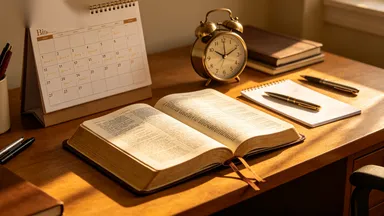
Reading the entire Bible takes most people between 50 and 70 hours total. That’s about the same amount of time you’d spend watching two seasons of a TV show. And if you read just 15 minutes a day, you can finish the whole thing in under a year.

If you’ve ever thought about reading the Bible but felt overwhelmed by how long it is, you’re not alone. The Bible has 66 books, over 1,000 chapters, and nearly 800,000 words. That sounds like a lot. But here’s the truth: it’s more doable than most people think.
If you have ever wondered how long does it take to read the Bible, the short answer is between 50 and 70 hours of straight reading — but the more useful answer depends on how you break that time up.
This guide gives you the straight numbers, breaks down different reading paces, and helps you figure out a plan that actually works for your life. No guilt. No pressure. Just a clear picture of what it takes.
How Long Does It Take to Read the Bible in Hours?
Before getting into reading plans, it is worth answering the question directly: how long does it take to read the Bible for the average reader at normal pace? Studies of audio Bibles and timed reading sessions converge on 70 hours give or take 10.

Here are the numbers based on average reading speeds:
At a slow pace (150 words/min): About 87 hours total. That’s roughly 17 minutes a day to finish in a year.
At an average pace (250 words/min): About 52 hours total. That’s 10 minutes a day for a year.
At a fast pace (350 words/min): About 37 hours total. You could finish in 6 months reading 12 minutes a day.
The average adult reads at about 250 words per minute. So for most people, the Bible is a 50 to 55-hour commitment from start to finish.
To put that in perspective: the average person spends about 3 hours a day on their phone scrolling social media. That’s over 1,000 hours a year. Reading the Bible cover to cover takes less than 5% of that time.
In other words, you already have the time. It’s just a question of choosing where to spend it.
Breaking It Down by Daily Commitment

Here’s what different daily reading habits look like over time:
10 minutes a day — Finish in about 12 months. This is the sweet spot for most people. You can read roughly 3-4 chapters in 10 minutes.
15 minutes a day — Finish in about 8 months. This gives you time to read a passage, pause, and think about it.
30 minutes a day — Finish in about 4 months. Great if you’re serious about going deeper.
1 hour a day — Finish in about 2 months. This is more of an intensive study pace.
The key insight? You don’t need to carve out huge chunks of time. A consistent 10-15 minutes a day is enough to get through the entire Bible in a year. That’s about the length of a coffee break.
Which Translation Affects Reading Time
Some Bible translations are easier to read than others, which can affect your total time:
NIV (New International Version): Around 726,000 words. Written at a 7th-grade reading level. Easy to follow. Great for first-time readers.
ESV (English Standard Version): About 757,000 words. More word-for-word translation. Slightly denser but still readable.
KJV (King James Version): About 783,000 words. Old English. Expect to read slower because of the language style.
NLT (New Living Translation): About 740,000 words. Very readable. Thought-for-thought translation.
If you’re worried about reading speed, start with the NIV or NLT. They’re designed to be read easily and will help you build momentum.
Which Books Take the Longest
A handful of books make up a big chunk of the Bible’s total length:
- Psalms — 150 chapters, about 8-9 hours to read
- Isaiah — 66 chapters, about 3-4 hours
- Genesis — 50 chapters, about 2.5-3 hours
- Jeremiah — 52 chapters, about 3-4 hours
- Ezekiel — 48 chapters, about 3 hours
The good news? Many books are short. More than half the books of the Bible can be read in under 30 minutes each. Books like Ruth (4 chapters), Jonah (4 chapters), Jude (1 chapter), and 3 John (1 chapter) take just a few minutes.
If you’re just starting out, try beginning with shorter books to build confidence. Mark is the shortest Gospel (16 chapters) and gives you a fast-paced overview of Jesus’s life. Then move on to longer books as you grow into the habit.
Is It Better to Go Fast or Go Slow?
This depends on your goal. If you want to understand the big story of the Bible from beginning to end, reading through at a steady pace is a great approach. You catch things that you’d miss jumping around randomly.
But reading the Bible isn’t a race. Many people find that a slower reading pace with time for reflection leads to more lasting change. The goal isn’t to “finish the Bible.” It’s to understand what it says and let it shape how you live.
A good middle ground: do a yearly reading plan that takes you through the whole Bible, and don’t worry if you fall behind. Jump back in wherever you are. Consistency beats perfection every time.
A Simple Plan to Start Today
Here’s a no-fuss way to begin:
- Pick a translation. Download the YouVersion Bible app and try the NIV or NLT. They’re free and easy to read.
- Set a timer for 10 minutes. Not 30. Not 60. Just 10 minutes. Low barrier means you’ll actually do it.
- Start with the Gospel of Mark. It’s short, fast-paced, and tells the story of Jesus clearly.
- Follow a reading plan. YouVersion has hundreds of free plans. Search for “one-year Bible” or “beginner reading plan.”
- Don’t stop if you miss a day. Just pick up where you left off. Missing a day doesn’t mean you failed.

Reading the Bible is not about checking a box. It’s about letting the story of God shape your story. And the only way to do that is to start.
Here is something you can do today. Open the YouVersion Bible app (or grab a physical Bible), turn to the Gospel of Mark, and read the first chapter. It will take you about 5 minutes. After you read it, ask yourself one question: what does this tell me about who Jesus is? That’s it. That’s a good start.
For further reading, see Bible Gateway as an additional resource.
Final Takeaways: Reading Time and Daily Habit
If you have read this far, the most honest answer is: it depends entirely on how you measure. Counted as raw audio time, around 70 hours. Spread across a 365-day plan, just 12 minutes a day. Spread across a 90-day sprint, closer to 45 minutes a day. Spread across whenever you happen to feel like reading, it never gets done. The number that actually matters is not the total hours — it is the daily commitment you can sustain.
Most people who ask the question are really asking a different question underneath: will I be able to stick with it? Almost nobody finishes the Bible by force of will alone. People finish when they pair reading with something they already do daily — coffee, commute, bedtime, lunch break — and stop trying to find extra time. Pair it with an existing habit, and the 50-70 hours will pass without you noticing.